








Customizable shoes, lemon water, a self-sufficient pool cleaner, and an accessibility focused clothing line. These and other products found a cohesive stage at this year’s 12th annual Nisbet Venture Fund Competition. 15 teams, made up of students and recent alumni alike, competed for a myriad of awards ranging from a monetary value of $2,500-$25,000. For the first time in Nisbet Venture fund history, all of the winners were first years.
Hosted by the Hurt Hub @ Davidson, the event is a coaching and mentorship program that helps teams of students and recent alumni develop their pitches and present to a panel of judges to compete for thousands of dollars worth of investments in their companies and products. The pitches are broken up into two separate funding pools: the Incubation track which competes for $5,000 and the acceleration track which competes for up to $25,000. 11 teams competed on the incubation track and 4 teams competed for the acceleration.
The first award given out was the Entrepreneurial Excellence Award valued at $2,500. Liz Brigham ’04, Executive Director of Innovation and Entrepreneurship, noted that this award represents the demonstration of entrepreneurial spirit. “[It’s given to] someone who exemplifies the sort of grit and perseverance that we and integrity that we expect of an entrepreneur,” Brigham said.
This award was given to Dongjoo Ahn ’29, who founded Aqualux, a company that creates pool robots that make chemical measurements and maintenance easier than ever. “Join us in reinventing pool care because the hardest part of pool season should be choosing which float you’re going to dive in with,” Ahn said in his pitch.
Eli Lacey ’29, founder of Align Stabilization, and winner of this year’s incubation track created his new cutting-edge knee sleeve after listening to feedback from a survey he conducted of people frustrated with the typical knee brace design. “This showed me that modern patella tracking knee sleeves are built for the patient and not the athlete […] that’s when I created Align,” Lacey said.
Lacey redesigned the classic patellar tracking knee sleeve, prioritizing fit, function, and aesthetic to best suit the user. Lacey won $5000 designated for early stage ventures.
Lacey attributed his pitch’s success to his cultivated presentational skills that he learned by performing. “The reason why I became good at story telling […] started out with my acting,” Lacey said.
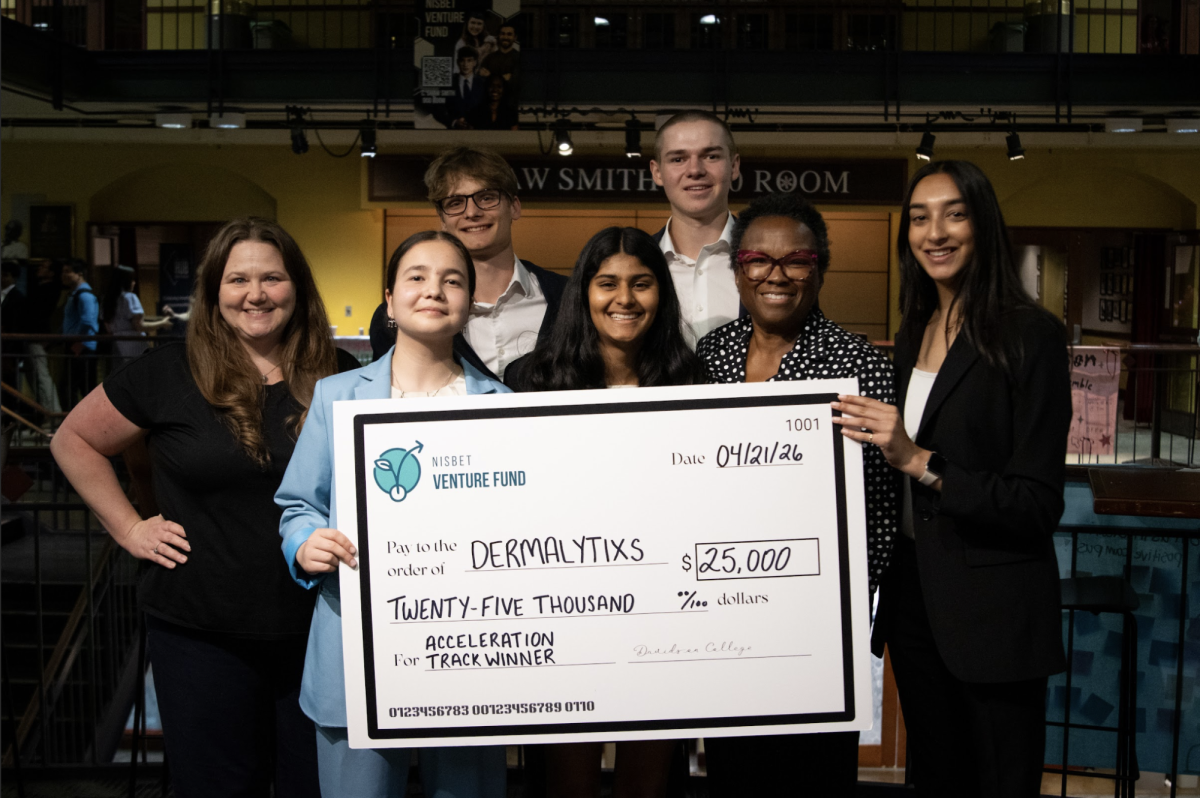
The last award of the night was the Acceleration track. Teams that participate in this track have demonstrated a marked investment in their product. This includes already having amassed $5,000. The track’s grand total of $25,000 was awarded to Dermalytixs.
Team Dermalytixs member Casey O’Keefe ‘29 gave a brief description of their product. “We’re creating rapid test strips for a deadly pathogen [by] applying the same technology that was used for COVID tests,” O’Keefe said. This deadly pathogen is Pseudomonas Aeruginosa, a bacteria that is the most common in causing infection among humans.
The Dermalytixs team is made up entirely of first-years including Leeya Chaudhuri ‘29, Arya Mody ‘29, Calvert Ross ‘29, and Jennet Ylyasova ‘29. This team partnered with community mentor Maria Kemp and Scientific Mentor, Nicole Snyder Professor of Chemistry. “[Snyder’s] early vision helped significantly to shape the foundation for this project and she continues to help us grow,” Ylyasova said.
Now equipped with a $25,000 equity investment from Davidson College structured as a Simple Agreement for Future Equity agreement, the team is hoping to continue to develop their device. In a wider application, they say their medical device could save thousands of people a year by cutting down on the time it takes to diagnose an infection.
The gravity of the situation did not escape the team members: “I felt like Steph Curry after a big win,” Chaudhuri said.