




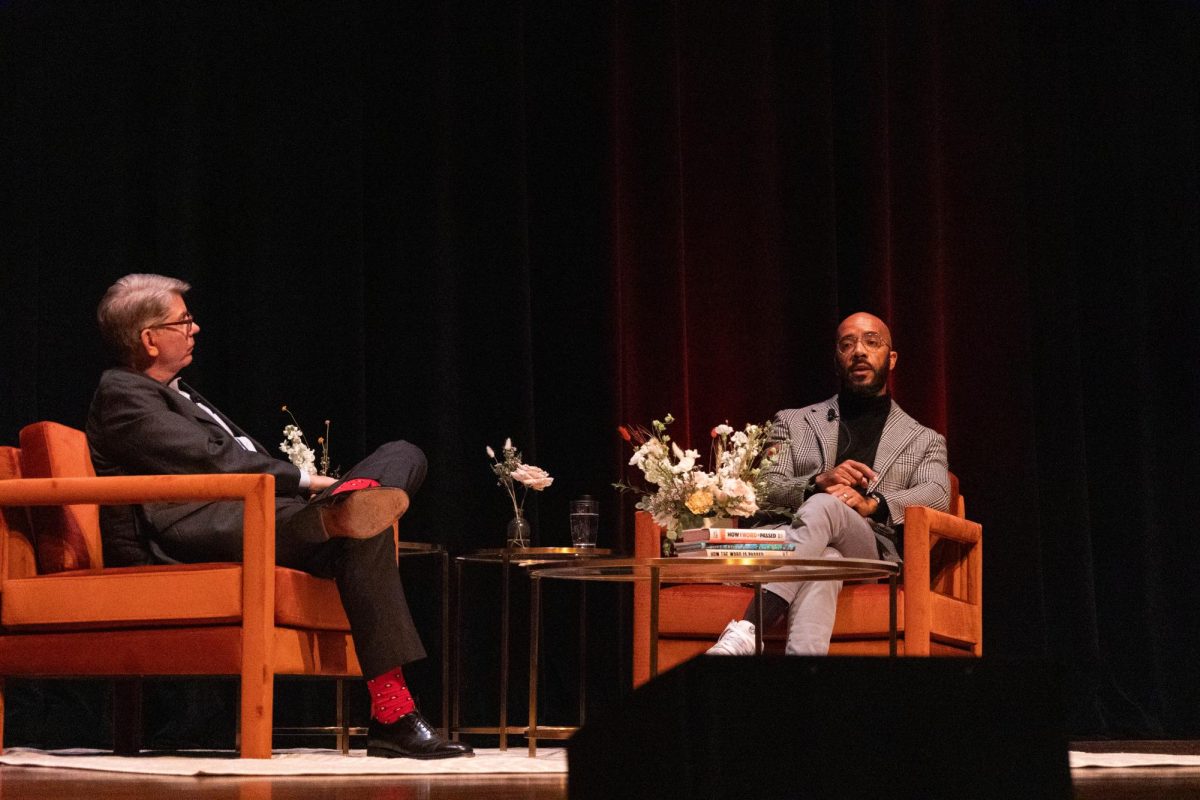
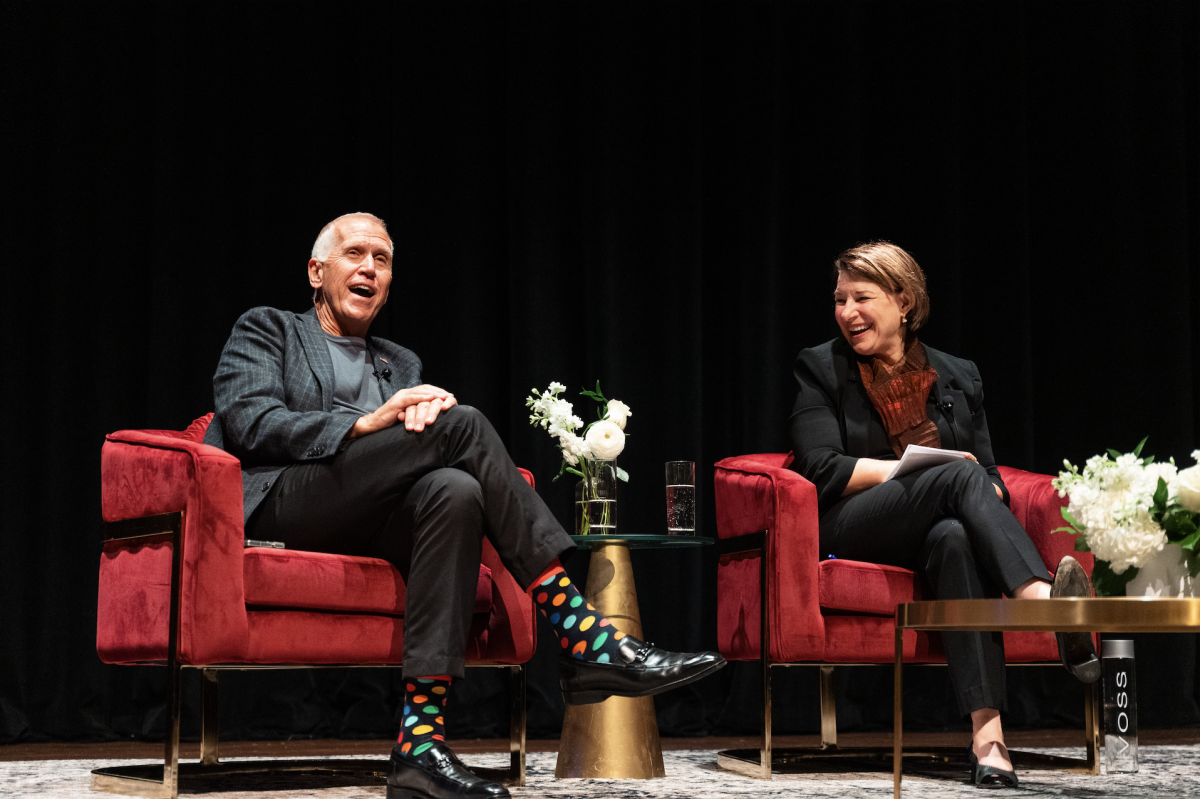


Davidson’s five living presidents gathered in the Duke Family Performance Hall on Thursday night to reflect on Davidson’s values before a nearly sold-out audience. Hosted by the recently renamed Martin Institute for Public Good, the conversation followed an event that morning announcing the new name and over $47 million in funding.
Titled, “Davidson’s Enduring Values: A Conversation with Davidson’s Presidents, Past and Present,” the event brought together John Kuykendall ’59, Bobby Vagt ’69, Tom Ross ’72, Carol Quillen and Doug Hicks ’90. Each led the college under different eras and with distinct leadership styles. Chris Marsicano ’10, director of the Martin Institute, said that the discussion reflected both the college’s values and the Institute’s mission of bringing together diverse perspectives to find common ground.
“When you talk about the [presidents’] values, the values of leadership, of service, the things that we believe are critical to a Davidson education, they have lived out those values in different ways,” Marsicano said.
Anthony Foxx ’93, chair of the Board of Trustees, opened the evening by welcoming guests and thanking the presidential spouses and past board chairs for their service to the college. He then moved to the event’s main focus and welcomed the evening’s speakers to the stage. “A Davidson president needs no introduction,” he declared.
The curtain rose to reveal the five presidents seated together onstage around a table, framed by bookshelves displaying Davidson memorabilia. A bridge between the past and present, Hicks moderated. He opened by asking Kuykendall, president from 1984-97, how the College’s values have evolved over time.
Kuykendall’s response reached back to Davidson’s Presbyterian roots and brought them to the College’s present need for change. “Davidson has got a very distinctive root, rooted in the Reform tradition and that part of our Reformed theology, which says that there is room for growth and development,” Kuykendall said. “One of the things I’ve always said about Davidson is that it needs to get better, which is a real positive in my mind for getting things done now.”
The question framed a recurring theme of the five presidents’ remarks: trust, both within and beyond the Honor Code. They defined the Honor Code as a core value that sets Davidson apart, shaping not only leadership at the college but the character of the broader community.
Quillen, who was president from 2011-2022, emphasized that the Honor Code underpins intellectual risk-taking.
“The Honor Code is about building a community where people can genuinely expect to be able to trust each other,” Quillen said. “We’re asking students to take huge risks, question their assumptions, present new ideas, speak when [they]’re not sure, find new avenues of inquiry. We’re asking people to take huge intellectual risks […] when I think about what makes Davidson different, I rely heavily on that.”
The conversation also explored Davidson’s commitment to accessibility. Vagt, president from 1997-2007, spoke about the creation of the Davidson Trust, an initiative designed to meet 100% of students’ financial needs and eliminate debt so that students can attend regardless of their background.
“[The Trust] was all about who we were as an institution,” Vagt said. “How can we sit here and not make it possible—perfectly possible—for any student who wants to go here to attend […] this is who we are and this is what we need to do.”
“It really has been a key moment, just as the Honor Code is and just as our attentiveness to every student and their dignity is, this attention to access and affordability is vital to who we are,” Hicks added.
Athletics were also highlighted in the discussion. Quillen noted that athletics are, not just extracurricular activities but opportunities for character development and an extension of the college’s educational mission.
“There are skills and opportunities and talents that get developed through playing sports at the highest level of competition […] and you need coaches who think of themselves as educators, you need students who are students first,” Quillen said.
For the presidents, athletics exemplify teamwork, leadership, integrity and responsibility—all lessons that carry into the classroom and broader campus community.
Hicks closed the conversation by expressing optimism about Davidson’s current momentum while emphasizing that the college’s work, and commitment to its values, continues.
In a follow-up interview with The Davidsonian, Ross, president from 2007-2010, and Quillen shared what they hoped students would take away from the discussion and why revisiting the college’s values matters today.
“We’re living in a chaotic time—lots of news coming at us, fast policy changes, deep political divisions—and for many people, things feel precarious, we don’t know what could happen next,” Quillen said. “At times like this, grounding values can be steadying, and talking about them can remind us of ideals that we can all share.”
“That character, the integrity you build—that sense of honor that the Honor Code gives you—you have the responsibility to take that out into the world and use it,” Ross echoed.
Cate Fitzgerald ’29 said that, for her, the discussion’s impacts extend beyond the stage. “It really inspired me to find ways to be a leader, not only in outwardly expressive ways, but in the smallest ways as well.”
This sense of inspiration contributes to the Institute’s broader purpose of hosting the event: emphasizing Davidson exceptionalism.
“If you feel special, it’s because you are. Davidson is special in the national landscape of higher education,” Mariscano said. “What makes us special is that constant reminder that we are here to have humane instincts and disciplined and creative minds for lives of leadership and service. That honor and integrity that we hold ourselves to—that makes us different.”