






Integrating pop art and native voices: Reflections on Tom Farris’ visit
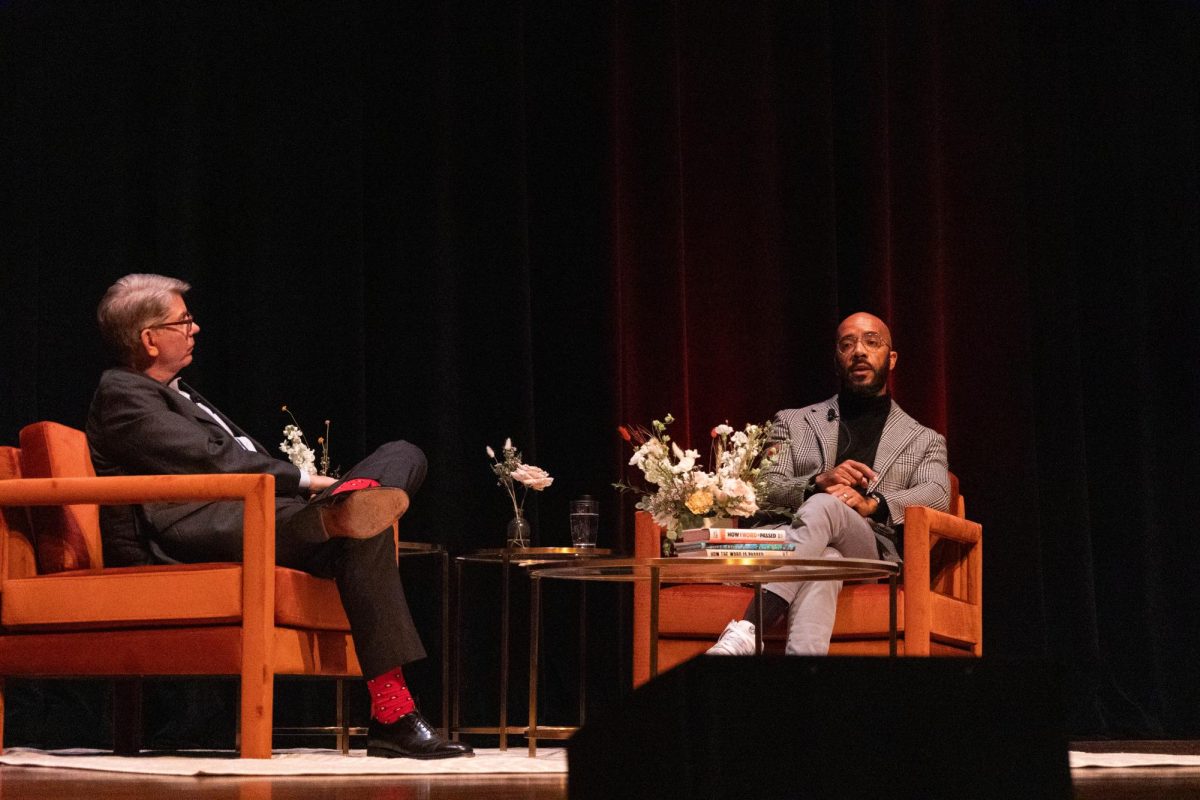
What happens when comic book heroes intersect with Indigenous identities and Native stereotypes become satire? Tom Farris, citizen of Cherokee Nation and Otoe-Missouria tribe, recently visited Davidson for a two-part event centered around his art. The programming included a luncheon detailing his artistic portfolio that fuses familiar cultural emblems with Indigenous meaning and critique, as well as an afternoon woodblock print workshop.
Especially as Davidson seeks to expand its relationship with Catawba Nation—through collaborations across the Sustainability Office, History and Biology departments, and the Van Evry Smith Gallery—Farris’ talk served as a step in the right direction for the students, professors, and community members who attended. The day offered opportunities to reflect on American-Indian art and Indigenous influences on pop art.
For many students, the most meaningful part was the workshop that followed in the VAC which gave participants the opportunity to engage with Farris’ acrylic-based printmaking technique directly. Bea Henderson ’27 and Miriam Ragsdale ’28 assisted with the event, after getting the opportunity to sign-up and help two workshops as part of their Advanced Printmaking class.
Henderson, an art history major, appreciated the accessibility of the printmaking technique. “It’s something you can’t really mess up,” she said. Henderson found it rewarding to help facilitate pieces with so many community members.
For attendee Kella Jahn ’27, the event also prompted reflection. “[It’s] hard to reckon with complicated histories especially when it’s a history that involves imperialism,” Jahn said. “Trying to reconcile in ways that involve knowledge, that is a good start.”
Raised by Native art collectors, Farris was exposed to Indigenous art traditions and Native art markets from an early age.
Throughout his childhood, Farris was an avid lover of comic books and animation, yet repeatedly found himself frustrated with the Native stereotypes in these popular culture forms.
“They often threw in Native characters with little thought towards the development of the character,” Farris said, replacing a concrete storyline with feathers, fringes, and other ambiguous, shallow symbols of Native identities.
While he was initially far more familiar with the business side of art given his parents’ ties to art markets, he eventually shifted to learning how to produce his own via YouTube videos.
Now, Farris is a multidisciplinary artist based in Norman, Oklahoma, who experiments with painting, woodwork, relief carving, and printmaking, though he continues to seek out new mediums.
Farris described himself as someone who has “a problem with instant gratification,” which is why he’s so attracted to the accessibility of printmaking. “You can get really fancy and use lino or wood blocks or you can use a pink rubber eraser and make a little mini print,” Farris said.
Farris calls himself a “child of the pop culture mindset,” meaning his work is shaped by the cultural phenomena he grew up with. The luncheon, in particular, highlighted how Farris draws on familiar imagery to challenge stereotypes about Indigenous communities, seeking to assert a Native presence in contemporary American art.
His piece (S)uperman depicts the DC Comics superhero with long hair and integrates the Cherokee letter for “S” in the title. His “Say What” series blends humor and critique through View-Masters discs that connect his childhood memory with contemporary identity issues that Native communities encounter.
“Say What,” a collection of 25 images and silk screens features a blonde woman depicted in pop art format and questions that Native people encounter, such as “What does “Skoden” mean?” “Can I touch your hair?” and “Where can I buy a dream catcher?” For Farris, microaggressions that his community faces ultimately transform into artwork.
Beyond his artwork, Farris has also played a role in expanding the Cherokee alphabet. For one of his pieces, he had to come up with a way to say “hoverboard,” which led him to the Cherokee Nation Language Department—a department within the Cherokee Nation government based in Tahlequah, Oklahoma—to come up with the proper translation.
During the lunch, he noted that “they either love or hate to see me coming because it’s always something unique,” pointing to his contributions that refuse deferring to American terminology but rather help the Cherokee language develop.
Native people have endured hardships throughout American history, despite prominent narratives often omitting their experiences. Some of Farris’ pieces confront this historical trauma. His refurbished slot machine, “Tools of the Trade,” replaces traditional symbols with images representing alcohol, religion and other means used in the past to steal land from Native people.
The machine serves as both a rigged game that nobody wins and a reference to tribal gaming’s role in economically empowering the Native community.
The “Shifting Paradigms” car served as a recent, ambitious project, in which Farris bought a run-down car and taught himself how to completely rebuild its front and rear end to make it functional again. He includes a Superman on the drivers’ side and vintage covers of war pundits on the side.
“It’s a White European car for a reason,” he noted, an intentional move to integrate Native voices in historical narratives.
By sending this message, Farris stresses that Indigenous art is not static but rather in a perpetual state of developing and reinventing, dependent on the artist and the message they are trying to send.
“I want there to be a hand-off where [younger generations] create art based on what’s exciting to them as children,” Farris said.
Savannah Soraghan ’27 contributed to reporting.