






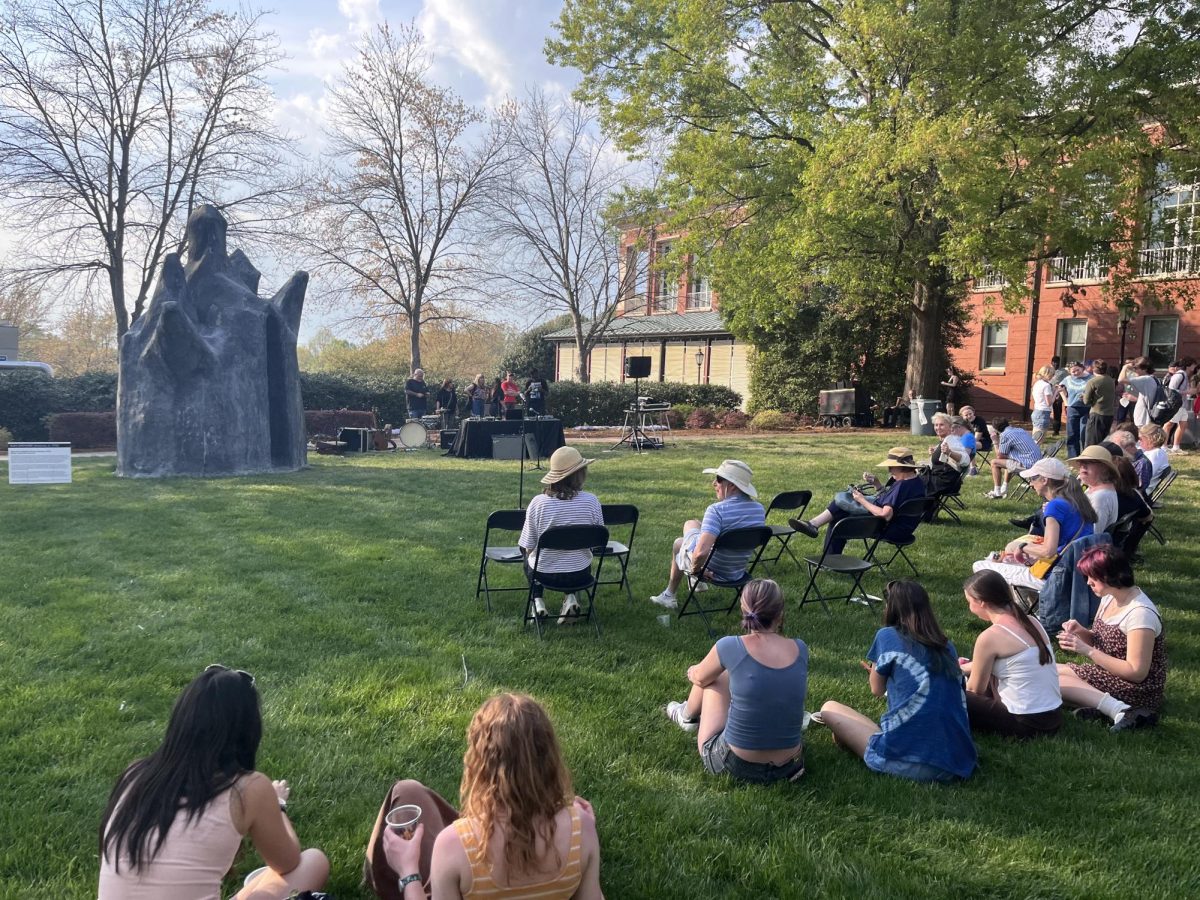
As the sun ducked behind trees on March 27, dozens of Davidson students, faculty, and community members watched Wake Forest Professor of Art Rudy Shepherd activate his artwork. His sculpture, titled “Black Rock Negative Energy Absorber,” was constructed on the lawn of the Visual Arts Center over the past two weeks. Its induction marked the end of the gallery’s sculpture-related programming that afternoon.
First, students had the opportunity to tour the campus’ wide range of sculptures, from the Rodin figure, “Jean D’Aire,” in the VAC to the fiberglass “Wind” sculpture outside Wall Academic center. Heidi McGannon ’26 and Sabrina Bonavita ’26 shared trivia and history as they led the tour.
The tour guides invited students to participate in a variety of ways, from prompting them to interpret the works to telling them to physically touch certain pieces.
“If you put your hand right here,” Bonavita said, gesturing to the Rodin work, “this was his handprint, so it’s like you’re touching Rodin.”
The tour also touched on the cultural roots of each artist who has left a three-dimensional mark on the campus.
As they discussed Magdalena Abakanowicz’ “Group of Ten,” a sculpture near the George Lawrence Abernathy Library construction site, they detailed her upbringing in Stalin’s Poland.
“[Abakanowicz] was really investigating that human condition, which makes a lot of sense given the fact that she was brought up during World War II,” McGannon said.
After the tour, the crowd moved to Shepherd’s performance on the VAC lawn.
Ellie Kim ’29 and other students were curious to watch the avant-garde induction ceremony. “They’re absorbing the evil spirit into the sculpture,” Kim said as the tour concluded. “I was like, I think that would be fascinating […] we should go.”
Shepherd graduated from Wake Forest University with a Bachelor of Science in Biology and Studio Art, and received a Masters of Fine Arts in Sculpture from the School of Art Institute of Chicago. His work explores the nature of evil and negativity.
The sculpture itself is a large abstract form made of dyed concrete, with a narrow archway and several nodes reaching skyward. Like his outfit and the provided refreshments, the sculpture is entirely black.
The twenty arranged chairs in front of the sculpture quickly filled up, leaving the crowd spilling off and onto the grass of the lawn. José Aviles was part of this group, stopping at the art exhibit during his visit from Texas. “I always like to see art and hear different stories,” Aviles said.
The group quieted as a recording of an unidentified woman’s spoken word poetry filled the air: “[W. E. B.] Du Bois said the cause of war is the preparation of war. I say the cause of peace must be the preparation of peace.”
From behind a midi controller and analog synthesizers, Shepherd manipulated the sound of the speech. Musicians beside him improvised atmospheric, futuristic music on a drumset, keyboard, guitar and bass. Shepherd then stumbled away from them.
He landed, on his knees, at the altar of his creation. A black bodysuit reduced him to a human silhouette, while his head was covered in a charcoal-shaped mask with only small holes for light and sound to peek through.
A quotation from Sun Ra, a black bandleader of the 20th century, overtook the speakers next: “I’m not real, I’m just like you. You don’t exist in this society. If you did, your people wouldn’t be seeking equal rights.”
Shepherd circled his sculpture as if in agony and confusion, draping the microphone stand around his shoulders like a scarf. He nestled the microphone into his mask and let out visceral groans as the music swelled.
In this half-blind trance, Shepherd often almost crashed into the speaker or an audience member. Shepherd, being able to see and hear much less than the crowd, was almost childish in his helplessness.
Natalie Fox ’27 was moved by this aspect. “The performance embraced the vulnerability in both healing and sharing artwork,” Fox said.
The sounds continued as Shepherd disappeared behind the VAC, finally returning in a t-shirt reading “Protect Trans Kids.” The music began to gain energy and melody as he joined the band members as himself. Shepherd turned inward to his fellow performers rather than out to the audience—seeming to make his band into a leaderless community.
He never spoke a word into the microphone.
The immersive, interpretive performance, combined with the day’s tour, allowed students, faculty, and community members to actively engage with environmental art.
The evening’s crowd members will remember the performance art which accompanied its invocation as the sculpture becomes a fixture of this lawn. It will remain there for a year.
Payten Jenrich ’29 was excited to bring sculpture out of the background. “I feel like it’s always in the corner of my eye and I don’t pay enough attention,” Jenrich said. “So this was good […] It’s good to know your campus.”