




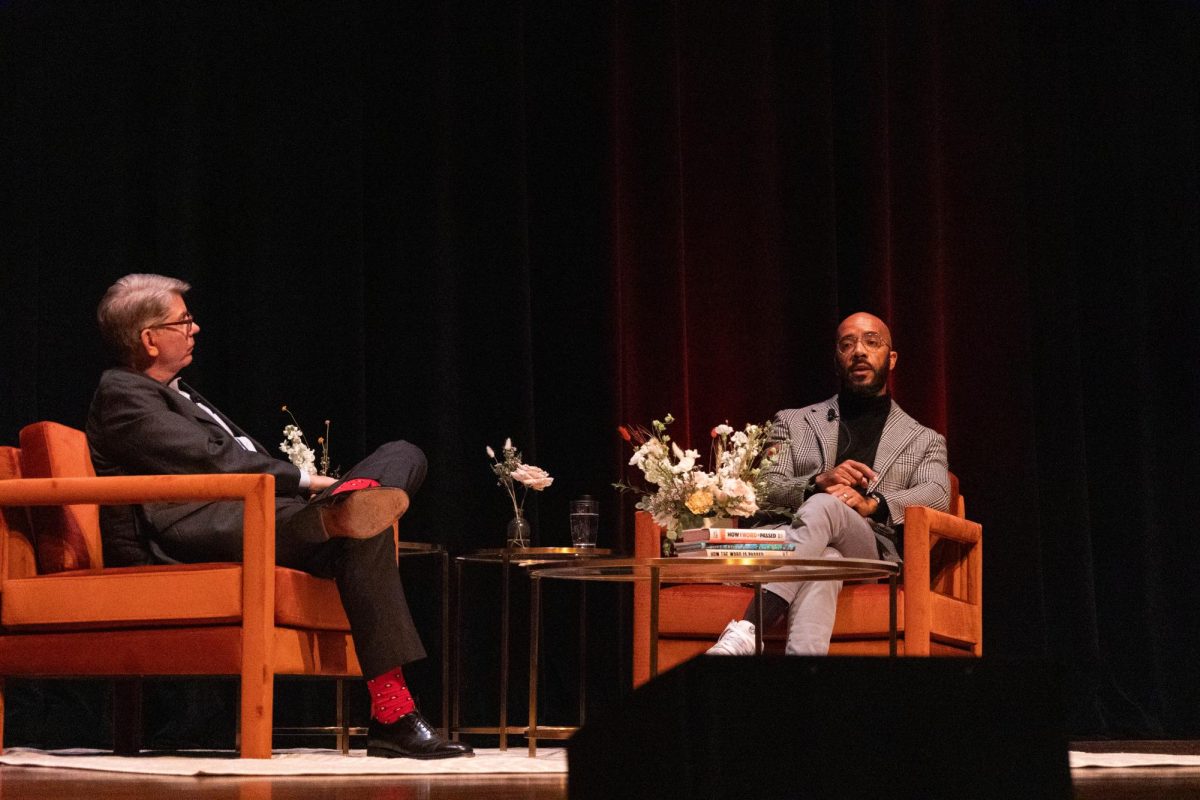


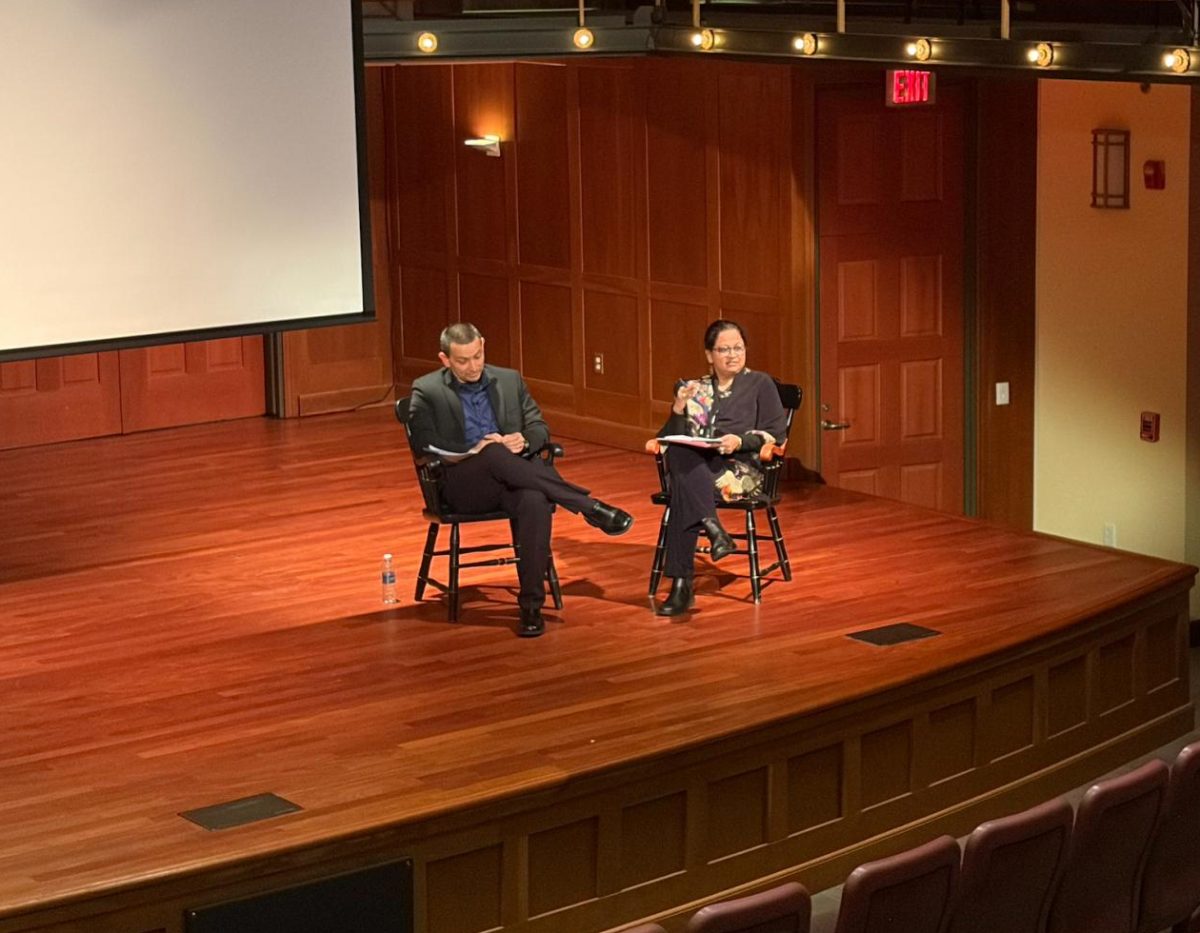
Students and faculty recently gathered for the Maloney-Otts Film Viewing which screened the 2021 film “Ahimsa Gandhi: The Power of the Powerless.” The viewing comprised just one part of a two-day series that explored the intersection of nonviolence, religion and social justice.
Although the Religious Studies department planned this event nearly a year ago, the current circumstances in Minnesota and racial tensions permeating the country have made the talk especially timely. Professor of Religious Studies Greg Snyder attributes the idea for this film viewing and discussion to Visiting Assistant Professor in the Religious Studies department Ved Patel, who specializes in Gandhi’s teachings and taught a course last spring titled “Was Gandhi Good?”
Conversations within the course tapped into whether nonviolence has expired or if it remains a viable method of protest today. “Ahimsa Gandhi” sought to prove the latter, underscoring the role of nonviolence as an effective political strategy with a spiritually aggressive nature that can promote reconciliation amongst religious, cultural, and political differences. The film draws out Gandhi’s early life and his experience after getting forcibly thrown off of a train in South Africa, leading to his development of Satyagraha, a form of non-violence resistance that strives to convert rather than defeat the opponent, in 1906. His teachings and influence ultimately manifested themselves in some of the most influential protest movements in India, South Africa, the United States, Poland and Czechoslovakia throughout the 20th century. While viewers also get a glimpse into various governments’ critical reactions and forceful responses to nonviolent protests, the moment of exhilaration comes after seeing these movements succeed.
In India, for example, the film highlights the 1930 Salt March, a 240-mile journey led by Gandhi in defiance of the British salt tax. Unarmed Indian demonstrators pick up salt in protest, a deliberate refusal of their government, leading to the arrest of over 60,000 Indians. Over time, though, the March instigated a widespread independence movement. Beyond India, the film suggests that nonviolent protest played a critical role in the collapse of communist regimes across Eastern Europe and the end of the Cold War, revealing their victories.
In the United States, the documentary focuses heavily on the Civil Rights Movement, particularly Martin Luther King Jr. and John Lewis. While King derived inspiration from Jesus Christ, his technique stemmed from Gandhi. The film excelled at exposing the costs of nonviolent resistance in a society where violence remains a constant threat, particularly with the 16th Baptist Church bombing shortly after the March on Washington. The end of the film further exposes this contrast, with a clip of then-President Obama speaking on racial justice played before the audio of George Floyd proclaiming “I can’t breathe” is heard. Images from the 2020 Black Lives Matter protests featuring violence accompanied Floyd’s final words on the screen, a visible antithesis of Gandhi’s message.
At times the film’s structure was puzzling. It jumps from India in 1930 back to 1920 then rotates between decades in the Civil Rights Movement with no clear explanation for these sudden switches. Meanwhile, some moments in the film seemed to drift away from the focus on nonviolence and read more like a retelling of historical events without clearly depicting how the protests intersected with Gandhi’s influence, or doing so too late.
Professor of Religious Studies Leela Prasad from Brown University shared remarks following the film, stressing that “you cannot resort to violence” no matter what. Prasad does not think of nonviolence solely as not resorting to arms, but also considers how one speaks, thinks of others, and the everyday ways people relate to one another as facets that contribute to violence. Rev. Adam Russell Taylor, President of the Christian nonprofit Sojourners, echoed Prasad’s thoughts while situating American society in a tug of war battle, with racial and religious diversity as a form of kryptonite that seems to fragment us exponentially more than it unites us.
Religious Studies major Ellison Baker ’27 felt that the film’s history was very relevant today. “The documentary highlighted a lot of what is going on in a modern context. It made very realistic claims about our country’s situation right now and our future.” To Baker, it displayed what can happen when violence or nonviolence is utilized as the primary mechanism of protest.
Although the film viewing did not offer easy answers to the frustration that many feel today, it is still a reminder of the myriad successes that nonviolence has instigated in the past. Refusing violence may just be the best way to democratize America’s democracy.