






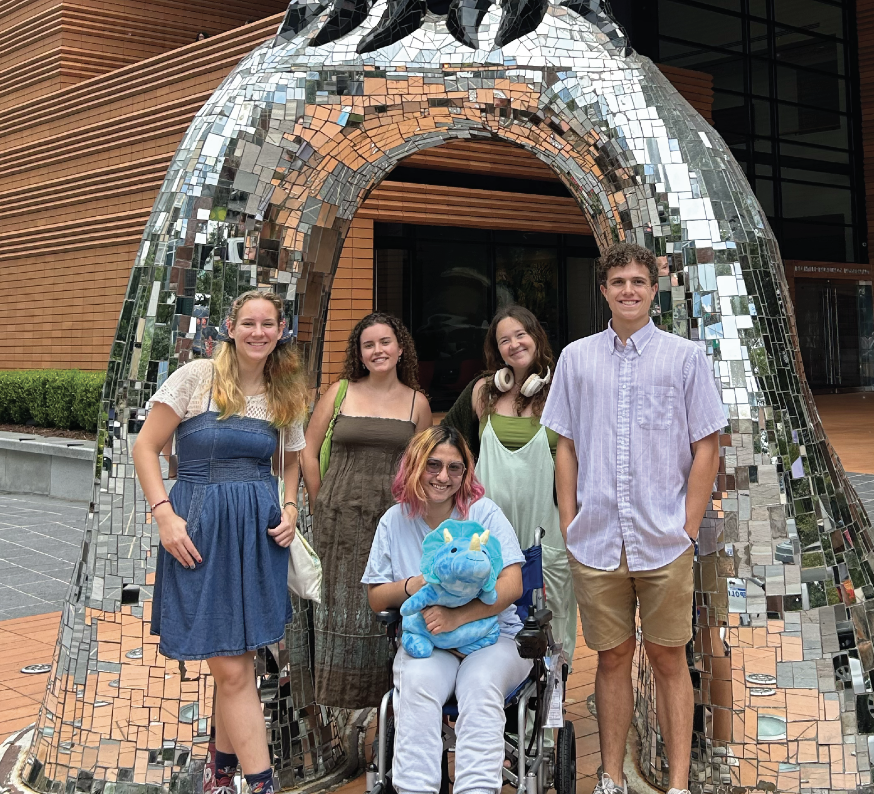
It has been about six months since DACE’s summer arts residency wrapped up its pilot run, and over the next three weeks applications will be reviewed for the next cohort. The residency is a nine-week long program for student-artists to live, work, and perfect their practice in a small community of peers and mentors. Last year the cohort included Annabel Semans ‘26, Belle Staley ‘26, Grace Catan ‘26, Ezra Minard ‘28, and Sarah Catalano ‘26.
Sherry Nelson, founding director of Davidson Arts and Creative Engagement (DACE), reflected on the inception of the residency program. Every month, she meets with a group of chairs of Davidson arts departments—theatre, art, dance, music, film, and literary arts—to discuss Davidson’s arts programming. “Two years ago, [we started] to think about some opportunity for artists on this campus that is equal to the research to Davidson Research Initiative,” Nelson said.
The Davidson Research Initiative allows students to work with a proposed faculty member on a project that fits the faculty member’s own scholarship. Though students can technically propose projects in any discipline with DRI, the initiative is not often utilized by student artists. “We wanted something that was really intentional and that would mirror what the professional opportunities would be for the students once you [have] graduated,” Nelson said.
The residency is much more independent and self-realized than a DRI project would be. According to Annabel Semans ’26, a songwriter in last year’s cohort, most Davidson pursuits necessitate that “you’re working towards a specified goal.” At a residency, the artist’s intent can shift throughout the duration. “The whole point is that that’s not necessarily conducive to the artistic practice,” Semans said.
By contrast, artist residency programs are designed to support artists, typically by allowing them to live in new environments and have time to refine their process. “If you are driven by just, you know, trying to practice and practice consistently, then you will inevitably create [a] product, and it might take you in unexpected and fruitful ways in the process,” Semans said.
The five artists accepted into Davidson’s summer cohort are given studio space in the Visual Arts Center and have access to mentors in a broad range of disciplines for the nine-week duration of the program. “We can provide opportunities for the student artists or the scholar artists to meet or come into contact with someone like themselves or not[…]it is about the creative flow and about what you’re learning and how you’re collaborating,” Nelson said.
The students were exposed to several visiting artists through weekly workshops, and were encouraged to engage with mediums outside of their own expertise—taking lessons from other disciplines as a result. Semans reflected, “I adopted techniques and exercises and ways of thinking from a choreographer and from a poet and from[…]a dance filmmaker.”
Grace Catan ’26, who used the residency to write a musical, lauded the program’s ability to help her find herself creatively. “My biggest discovery within the residency was allowing myself to replace my scenes with spoken word poetry,” Catan said.
One aspect Nelson hopes to expand in the future is collaboration between cohort members themselves. Cohort members spend most of their time with themselves and their art. “It’s mostly independent work time; that’s what a residency is. And it’s easy as an artist engaging in that,” Semans said.
However, the independent aspect of the program can have both positive and negative consequences. It can serve as a boon to everything a residency intends to do; allowing for experimentation, discipline, creation, and research. But, especially for Davidson students so used to community, Nelson notes that it can feel isolated.“[Next year,] we may have an intentional project that the group works on for the first week, you know, just to just develop something together,” Nelson said.
Because the cohort intentionally includes students whose focus spans many mediums, Semans sees potential for productive intra-cohort collaboration next year. “Concepts of practice are totally transferable across so many artistic disciplines[…]between the residents, the mentors, and most of our guest artists, almost all of them were from different disciplines,” Semans said.
Artists like Semans can expect to apply to residencies in their careers post-graduation. These residencies often have limited spots, but having completed one at Davidson may make the difference for applicants. “If you want to do a residency, a professional residency, you really need to have some residencies under your belt to be able to get to the[…]really great ones,” Nelson said.
However, the residency provides more direct results than its value on a resume. Parts of Catan’s musical, now much more developed, will be featured in her thesis performance in April. Semans has been developing her songs with instrumentation from her band Fool’s Errand. “Now a number of songs that I wrote from the residency are going to be in the program of my senior recital as a music major on March 21,” Semans said.
Coming out of the residency, several cohort members had a confidence in their art-making that they hadn’t before. Semans already considered herself a musician, but now she is proud to don the title of songwriter.
Catan felt similarly, emphasizing the impact of the program. “The residency helped me practice making art with others and sharing my heart in a way that I hadn’t before.”