




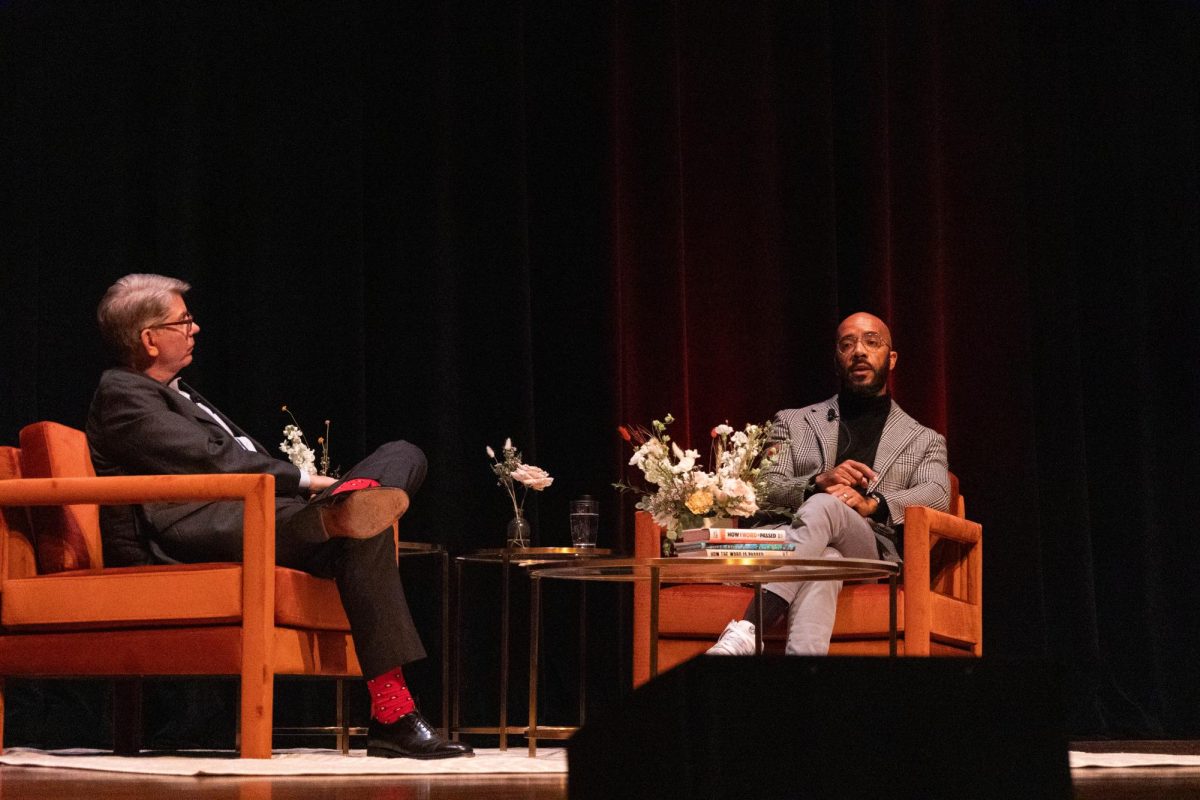
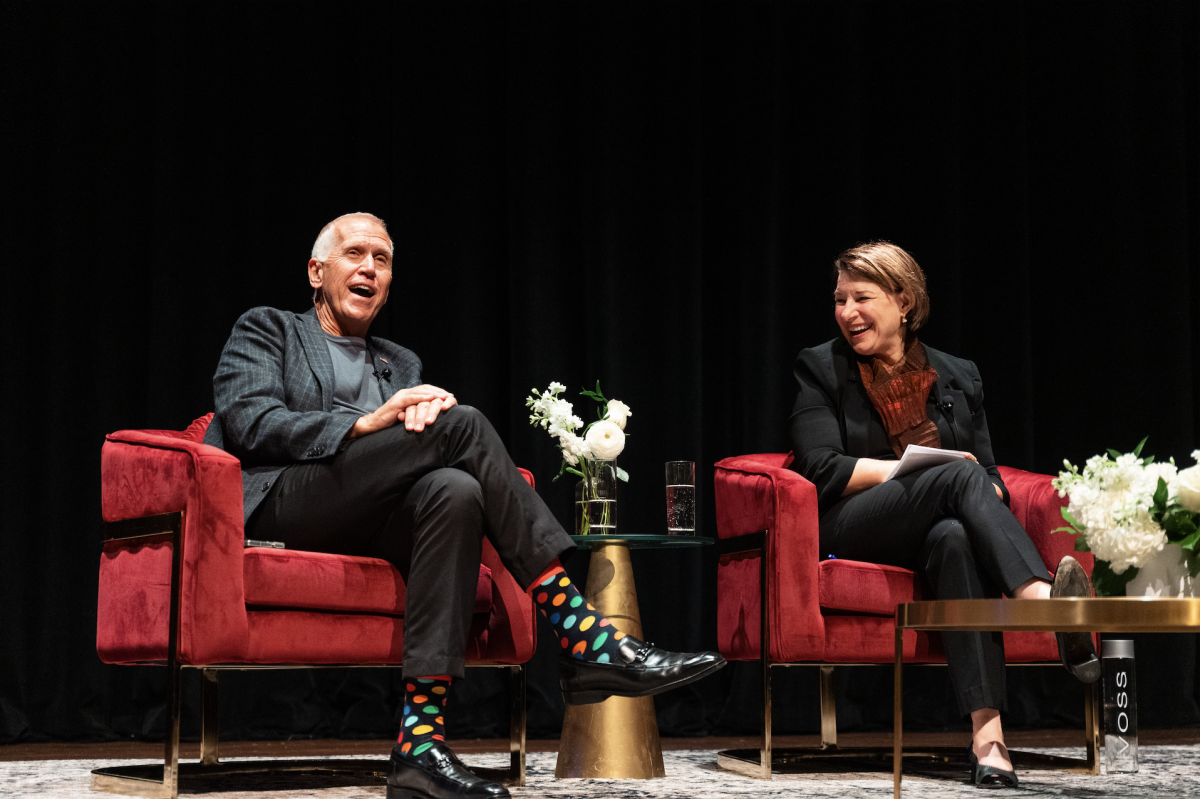


No one raised their hand when Isaac Saul, founder of the non-partisan political newsletter Tangle News, asked if anyone changed one of their political opinions in the past month. This exercise demonstrated Saul’s main point: in 2026, people do not challenge their own thought processes.
To a room of community members and students, the event hosted by the Center for Political Engagement aimed to start a dialogue about where people get their news and how they digest the information they read.
Saul founded Tangle in 2019 after a career as an independent journalist. He began his career with the Huffington Post and A Plus news. He wrote prolifically about the 2016 presidential elections, Yahoo News named him one of the 16 people who most shaped the election.
Saul’s achievements still left him wanting more. Growing up in Bucks County, Pennsylvania, a long time politically purple county, Saul was surrounded by both sides of politics. Yet, he observed how current political conversations rarely include a diversity of thought.
“We don’t change our minds about anything,” Saul said.
“Why is that?” he asked the audience.
The answer, in his eyes: our information ecosystem.
“Anytime we go online, where most people get their news, or we pick TV stations we really like and we go back to regularly, or newsletters […] You go back to it regularly, and they feed you the thing that they know that you like over and over and over again,” Saul said.
Through his experience as a journalist writing for the Huffington Post and CNN, he experienced these news biases firsthand. The AllSides media rating says CNN trends towards the left and the Huffington Post is left-leaning.
“When I left the Huffington Post and started writing in other places, people would look up my name and they’d see I used to work at Huffington Post and be like, ‘liberal hack,’” Saul explained.
He started Tangle News, which AllSides rates as centered, to remedy what he perceived to be a lack of unbiased political news.
“We needed very, very, very badly a media organization that could speak to people from across the political spectrum,” Saul said.
Even so, Saul stressed that their newsletter is not a replacement for all news, rather a supplement. “We couldn’t do the work that we do without the New York Times and Wall Street Journal and Fox News and CNN, MSNBC,” he said.
The newsletter highlights stories and reporting from these papers. Every article provides one section about what the left is saying, what the right is saying and a “My Take” where a Tangle writer provides their own opinion.
Saul credits the format with Tangle’s success. Beginning with 13 subscribers, they quickly grew to a newsletter with 500,000 readers.
He also credits some success to Tangle’s internal values, which strive to make politics personal and transparent. In the face of AI, Saul noted the need for a human-centered approach to reporting.
“If we’re sharing analysis on a major news story, we include personal anecdotes, and I encourage my staff to do that,” he said.
Saul believes these perhaps “unconventional” writing practices help structure the other core beliefs of the organization, authenticity, consistency, open-mindedness, humility, skepticism, integrity, respectfulness and compassion.
Saul also wants to address lack of trust in the media. He does this by being transparent with his audience.
“If you have a correction in the newsletter, we feature it prominently. We don’t hide it as a footnote,” he said. “If we’re asking readers to become a paying member, we try to tell them why. We say what the money is going to go toward.”
Tangle’s dedication to non-partisan news is also reflected in their hiring practices. Journalists, Saul noted, are historically left leaning. A study published by Science Advances corroborates the story, showing that 78.1% of their sample size of journalists trend more liberal. Nevertheless, the study shows that their views do not impact which stories journalists chose to cover.
With this pattern in mind, Saul said that Tangle aims to hire people with a variety of political backgrounds and views. This also improves their reporting because people are able to challenge one another and their potential biases. “That’s like the fundamental diversity of thought power in the newsroom,” Saul said.
Saul simultaneously acknowledged the lack of class diversity in their newsroom. “That is definitely a blind spot that we have, that I try to be really cognizant of.”
However, Tangle remains devoted to diversity of thought. This ethos is how Tangle and Saul first gained traction when in 2016 Saul wrote a story about how he changed his mind on Hillary Clinton, about whom he had previously written a strongly-worded op-ed. Afterward, he apologized for what he wrote. “I got really positive feedback from people I wasn’t expecting,” he said. He later received a letter from Clinton in which she thanked him.
However, his material was not always so well-received. Another time, Saul wrote about how he changed his mind and went from opposing voter ID laws to supporting them. “That really angered a lot of our left leaning audience,” he shared. “So it doesn’t always […] win credibility points. Sometimes it just makes people mad.”
Despite his deep commitment to non-partisan news and believing in its power, Saul also acknowledges some of its downsides. “Something that’s problematic about our work is like we are reinforcing the divide in some ways by saying, ‘This is what the left is saying,’ ‘This is what the right is saying,’” he said.
In some ways, Saul observed that the strong divisions in politics stem from a lack of funding for the media. “The more sustainable the media is, the less pressure there is to make it entertainment and sensationalized stuff,” he said.
Still, Saul advised his listeners to be aware of the news they are digesting, especially given the consumerist state of news. “Think literally about every single thing you click on as just giving someone $1,” Saul said.
He ensured that the audience understood that what they chose to read matters. “You go to the New York Times homepage and there’s a story about Trump cheating on his first wife next to a story about a $100 billion healthcare bill. Which story do you click on?” he asked.
Saul ended on a positive note, asserting that despite living in divided political times, there is still good in the world. “The real world is just not as indecent as our politics and our news are.”
The message resonated with audience members. “His note about decency gave me a little bit of hope for the future,” Josh Sun ’27 said.
Buncie Hay Lanners ’84 felt similarly, and urged people from across political backgrounds to talk to one another. “These kinds of discussions are so important to get us back to our humanity, get us back to our decency, get us back to listening and to finding the way, not just the one way, but the way that might bring in a lot of different answers to solve problems,” she said.
Saul’s lecture raised a lot of questions, most of which were open to all for discussion. However, he strongly endorsed one point: people need to challenge their own views.
“Think about actively whether your deeply held perspectives are being challenged by the content you’re consuming, and if they’re not, then there’s probably something wrong,” he said.