




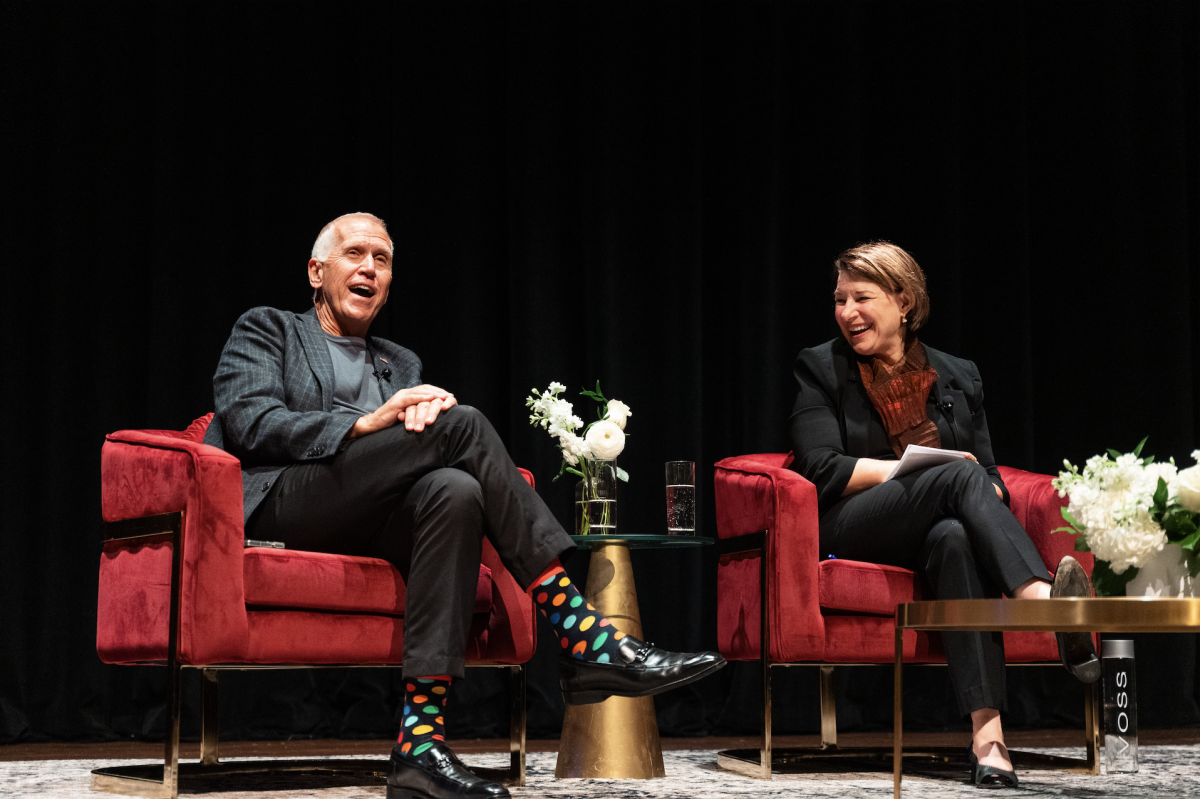


Davidson College students are not the only students in town. Beyond the College’s perimeters a non-profit organization, DavidsonLearns, is transforming rented event spaces into classrooms and providing adults with college-level classes, lively conversations and a sense of community.
DavidsonLearns was established by six community members in 2012 under the name the Lifelong Learning Institute. Their first semester they offered two courses taught by two Davidson professors, Tony Abbott and Susan Roberts. Since then, the program has expanded expeditiously. This Spring, there are 27 courses being taught and the organization itself has a total of 800 active members.
The course offerings are expansive, ranging from psychology classes, such as retired Davidson psychology professor Greta Munger’s course “Visual Arts and the Mind” to Davidson German studies professor Scott Denham’s seminar on Hannah Arendt.
DavidsonLearns is not affiliated with the College and Davidson professors are not the only faculty members. Some are retired professors from other universities including the University of North Carolina at Charlotte and Wake Forest University; others are professionals who provide expertise in their field.
The classes vary in size and length. Some classes are only two sessions and 25 people. Others last eight weeks and fill lecture halls.
“There’s a man who works for Microsoft, and he taught a class on AI. I heard that one was really popular, very popular. That’s been our largest class, it had 90 people,” said DavidsonLearns Assistant Executive Director Allyson Ray.
Regardless of the professor’s backgrounds, their volunteer teaching enriches the community and provides people with high-quality education. “It’s a really fabulous thing,” said retired classics professor Jane Neumann.
Neumann, like many others, is both a teacher and a student. She has been a part of the program for ten years, teaching classes about Homeric Hymns and Pompeii and taking courses on southern women’s history and a seminar on Leo Tolstoy’s War and Peace, taught by Russian studies professor Amanda Ewington.
Ewington teaches War and Peace with DavidsonLearns and at the College. Though the courses are done in very different time spans as DavidsonLearns classes typically only last five to eight weeks.
Because the two courses align, Ewington is able to facilitate interactions between her undergraduate and adult students. Occasionally, she invites her DavidsonLearns students to her class to have group discussions with her college students; other times she encourages them to come to the Verna Miller Case symposium to cheer on her presenting students.
“It brings an audience beyond Davidson. It’s kind of exciting to have other people listening,” Ewington said.
This class model brings students and community members together. As DavidsonLearns students tend to be retirees, the life experiences between the two groups of students differs greatly and allows for intergenerational learning. Ewington has found this dynamic unique, especially when discussing Tolstoy’s novels.
“I do think it brings a life experience when you’re reading these novels that are talking about the kind of meaning of marriage and the change and love over the years and challenges. Tolstoy’s really interested in exploring marriage,” Ewington noted. “And so, I do think that having older people with some life perspective brings something to it.”
Denham’s courses follow a similar model. His seminars end with soirees where students present their work. In the audience sit his DavidsonLearns students who have read and analyzed the same texts. They are engaged audience members, eager to ask questions.
“That’s a really cool model [the soiree], and it’s sort of a maximalist DavidsonLearns model,” Denham said.
Outside of the classroom, DavidsonLearns continues to facilitate intergenerational educational connection. In Neumann’s specific case, she recalls when her and a former student of hers were both taking Ewington’s War and Peace class.
“He was taking the class, so was I […] so we had coffee a couple of times to talk about the book,” Neumann said.
Additionally, a class Denham taught at Davidson went on a Spring Break trip to Berlin and while they were not officially with the college, Denham invited the DavidsonLearns students to informally join the trip.
“I saw firsthand the way the DavidsonLearns people came and really enriched the conversation across generations,” said Ewington, who joined them on the trip.
Teaching the same class to two different age groups also allows for different kinds of questions to be asked. For Denham, every DavidsonLearns class ends with him learning something new as well.
“I learn always from the DavidsonLearns students through the kinds of questions they ask, [they provide] new angles on material […] because they’re old and wise. They’ve done stuff,” Denham said.
Because of the difference in life experience, many of the DavidsonLearns professors also have observed a significant difference in the classroom’s atmosphere. Munger, for one, has seen a difference in how the students approach the material.
“You’re talking with people who have had more time to travel, and so they’ve probably seen some of the paintings I’ve assigned for them in-person, and then I’m talking about the science behind how you just see the world,” Munger said.
The class she is currently teaching, “Visual Arts and the Mind,” focuses on color perception in art and teaches the psychology behind vision. She finds that her classes are able to make science more accessible.
“It’s a way to share science with some people who, in my classes, have mostly been women, and they’re of an age where they don’t really think they can do science, which isn’t true, so it’s been really fun to show them,” Munger said.
Like Munger’s class, many of the classes reflect an observable need in the community. Ewington first offered her course Russia and the West through DavidsonLearns in 2022 to address Russia’s role in the ongoing war with Ukraine.
“I thought, well, this might be a really good time to teach that for Davidson Learns, because it would be beyond the campus community. People have a real hunger right now for this kind of understanding,” Ewington said. “I wanted to teach about the history so they could understand the way he leverages historical memory and narratives to justify aggression against Ukraine,” she said.
She finds teaching DavidsonLearns students about these narratives a completely distinct experience than undergraduates.
“A lot of them have a Cold War mindset, where they’re kind of remembering when Ukraine was part of the Soviet Union. And there are some really basic things that I’m trying to get them to do, to respect Ukrainian sovereignty, like little things, referring to it as ‘Ukraine’ instead of ‘The Ukraine,’” Ewington explained.
DavidsonLearns classes provide a lot to the community outside of just classes. Amongst the DavidsonLearns students, a sense of community that expands beyond the classroom is built. Ray cited many examples of students coming to these classes, often retirees who just moved to Davidson, and finding lasting connections. One specific class on poetry taught by Nora Shepard has named themselves the “Shepards Flock.”
“They’re planning to meet regularly and still continue to write poetry outside of DavidsonLearns,” said Ray.
DavidsonLearns also includes many additional programming opportunities such as ‘Spotlight speakers’, educational trips and cross-promoting events with the College. The non-profit’s income is only used to cover operational costs such as rental spaces, and students who can not afford classes are encouraged to reach out for financial aid.
“If somebody calls and says, ‘I can’t afford it,’ we pay for it,” said Ray.
Still, there are still questions about its accessibility. “It’s an economic bubble,” Denham said.
Though it is “not an ideological bubble,” Denham continued. DavidsonLearns attracts all types of students from varying backgrounds. Denham cited one memorable student, a “life-long republican” who values lifelong education.
“He has come back every time for things that challenge his worldview,” Denham said.
DavidsonLearns also expands beyond the Town of Davidson. Both Munger and Denham have students who make the drive from Charlotte to Davidson for the classes. “They’re driving distances to get here,” Munger said.
As DavidsonLearns continues to expand, so does its commitment to community and intellectual conversation. For students, it lets them find their “intellectual tribe,” as Munger said.
For the retired professors and experts, it allows them to keep teaching what they love to students who want to listen. “When you retire, you retire because you’re tired of grading papers, but I’m not tired of explaining the science I love,” Munger said.
The non-profit is a labor of community efforts whose impact in Davidson extends beyond the classroom. “DavidsonLearns can serve the college community,” Munger emphasized. “It’s a great value.”