






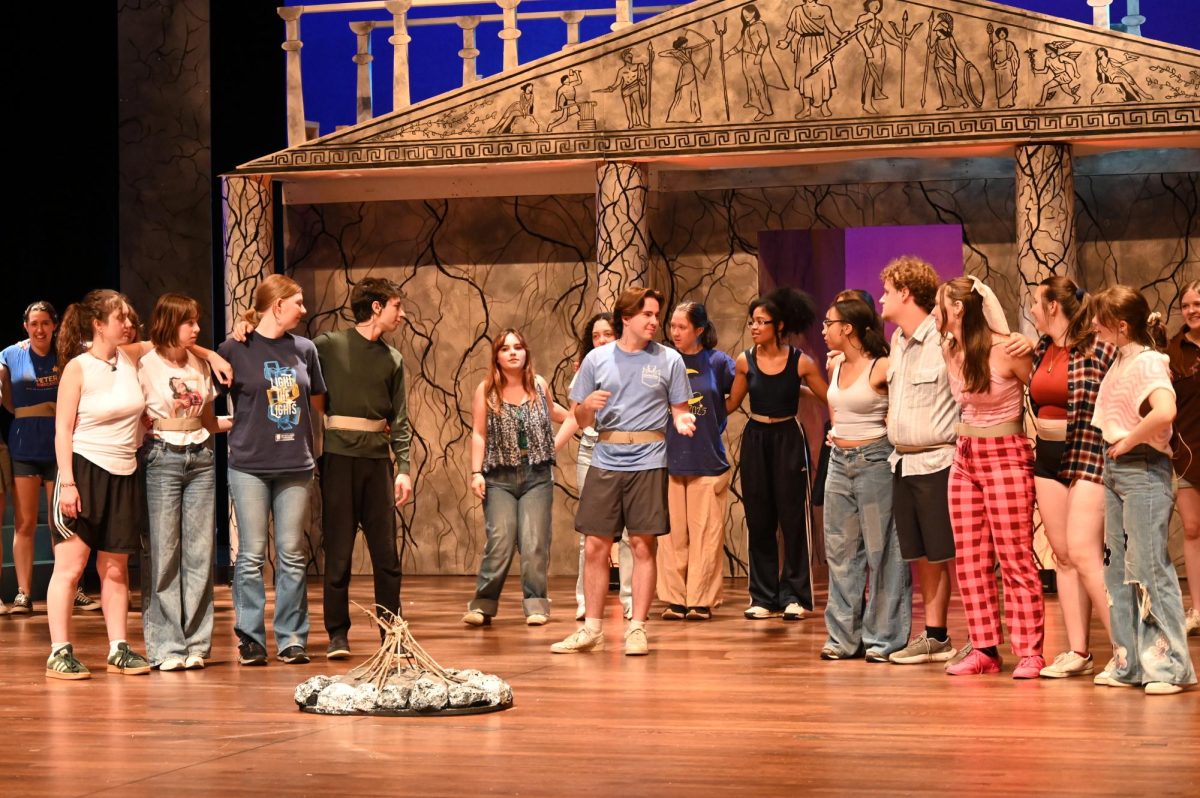
For better, and sometimes for worse, Dionysia Theatre Company’s production “The Lightning Thief: The Percy Jackson Musical” stays true to its source material.
“The Lightning Thief,” the original Percy Jackson novel written by Rick Riordan and released in 2005 adapted Greek characters and stories passed down for millennia. Now, after spawning an expansive book series, a 2010 movie adaptation and a 2023 Disney Plus series, it is easy to wonder if the story has lost its luster.
Fortunately for existing fans of the series and new fans alike, Dionysia Theatre Company, Davidson’s student-run theatre group, adapts the tale with a reverence for the themes that made the original novel so beloved. “The Lightning Thief: The Percy Jackson Musical” runs March 27-29 in the Duke Family Performance Hall.
The book was adapted for the stage in 2014 by Joe Tracz and Rob Rokicki. While the musical’s plot largely mirrors its source material, there are notable omissions and plot condensations to keep the roughly two hour runtime down.
Student director Hannah Holmes ’26 understands the importance of fitting the story to a new medium, describing herself as “not a book purist.” As suggested by the script, she did not consider race, gender or physical ability when filling out the cast.
The show follows troubled teen Percy Jackson (Akeelah Romeo ’28), who has been kicked out of several schools and struggles with dyslexia. Percy is attacked by a monster disguised as a substitute teacher on a field trip to a museum. This leads him to discover that his absentee father is actually the Greek god Poseidon, and Percy is sent to a summer camp for the children of the gods.
Soon after, he goes on a quest to restore peace amongst the gods alongside his friend Grover (Riley Light ’28) and the less friendly Annabeth (Morgan Watt ’29), where they encounter various mythical creatures and navigate relationships with each other and their families.
The production is at its best when it gives Romeo, Light and Watt moments to shine. Each one nails their emotional beats when called upon in songs like “Strong” and “My Grand Plan” that connect the show to the original novel’s meditations on family and self worth.
Romeo, who is female, is particularly impressive in her role. Romeo and Holmes agreed early on to keep Percy’s character male, and Romeo embraced the unenviable task of entering the headspace of a teenage boy. “I have a playlist called teenage angst that I listen to as well [as the musical numbers] before a show, songs I think [Percy would] listen to,” Romeo said.
Romeo also sought advice from fellow actors Ethan Brennan ’28 (Chiron) and Evan Oldenburg ’28 (Luke) on the physicality of the role. “I have to carry myself differently […] I have to have a presence for myself,” Romeo said.
Her preparation carries into a performance deeply relatable to anyone who remembers their teenage years, male or not.
However, the show’s most emotional moment comes courtesy of Grover. Midway through the second act, he laments to Percy the time he failed to bring a child of Zeus safely to camp in the number “The Tree on the Hill.”
Light struggled with the scene at first, but combined those failures with other feelings to capture the emotion needed for his performance. “I thought about what it would be like to lose my sister,” Light said.
However, there are also times where the more ‘teenaged’ aspects of the show can do the actors a disservice. While the play considers the characters slightly older, in the novel they are middle schoolers who say cringe-inducing things. Unfortunately, some of the cringe-inducing dialogue carries over to the stage with lines like, “Mom —if you’re weird, you’re weak” and, “We’re literally the reject cabin. Welcome to the dysfunctional family.”
A similar dynamic emerges with the show’s humor. Each character possesses a dry wit almost guaranteed to elicit laughs, with highlights including Mr. D (Franz Walton ’28) in the song “Another Terrible Day.” But several jokes devolve towards more rudimentary humor that, while likely appealing to a younger audience, might fall flat in a college production with a similarly mature audience.
Many of the script’s shortcomings can also be attributed to its ravenous desire for fan service.
Several lines of dialogue incorporate the book’s longwinded and quirky chapter titles in ways that may be gratifying to dedicated fans, but come across as awkward to anyone else.
Ethan Brennan ’28 (Chiron) considers the script another challenge of being an actor. “I just try to make it sound normal,” he said.
The musical also includes some exposition dumps that, while important pieces of worldbuilding in the novel, only serve to satiate fans and interrupt the expedited story of the musical.
This ultimately creates an issue of pace. So much time is dedicated in the first act to establishing characters and elements of the world not entirely relevant to the story that the whole of the quest is squeezed into the second act. It gives little time for the characters to develop and for the actors to work in emotional moments, a crisis most acutely felt in the resolution.
Still, despite the limitations of the script, the performances from the actors manage to shine through and carry the story. The musical numbers are delivered with a gusto that keeps the energy high throughout, and despite a rough exterior, genuine talent and emotion from the cast reveal the tender heart of a story about finding family and overcoming self-expectations.