






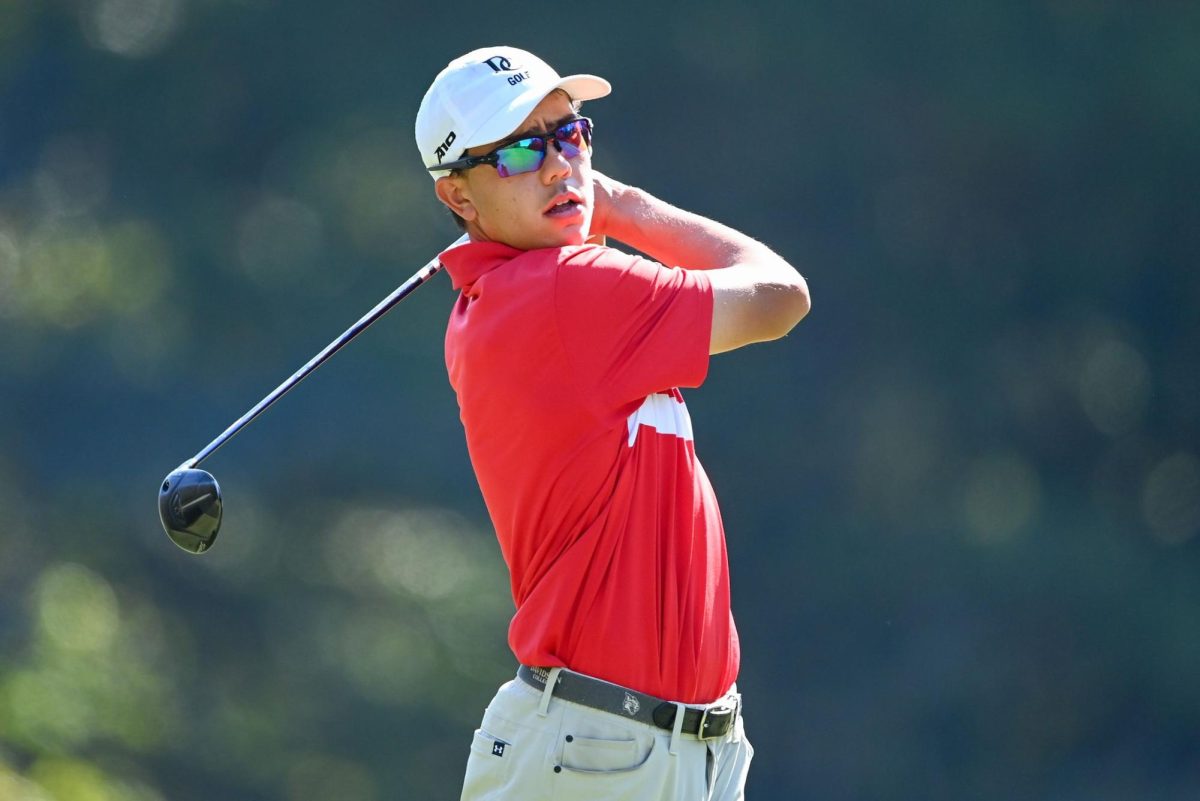
On a gusty Wednesday afternoon at the River Run Country Club, head coach Tim Straub patrolled the range as players alternated between hitting long shots down range and practicing on the chipping green 50 yards away. Despite finishing dead last at the Hal Williams Collegiate tournament in Mobile, AL, that weekend, Straub’s sights were set on the future: preparing the young team to compete in pursuit of their sixth Atlantic 10 Championship since 2018.
A persistent crosswind deterred Straub’s plans of doing wedge and driver drills. Instead, as the wind bent the flagsticks groundward, he let the team split up and prepare for their 4:30 p.m. tee times on their own. Players joked around between shots, but internally, they were all preparing for the upcoming qualifier—three-to-five day periods before each tournament where the team plays full 18-hole rounds to determine which five golfers will compete.
Straub uses the qualifiers, and other team competitions, to simulate the pressure his players will feel during tournaments. For him, that is where the difference is: success “will come to guys that handle the pressure well.”
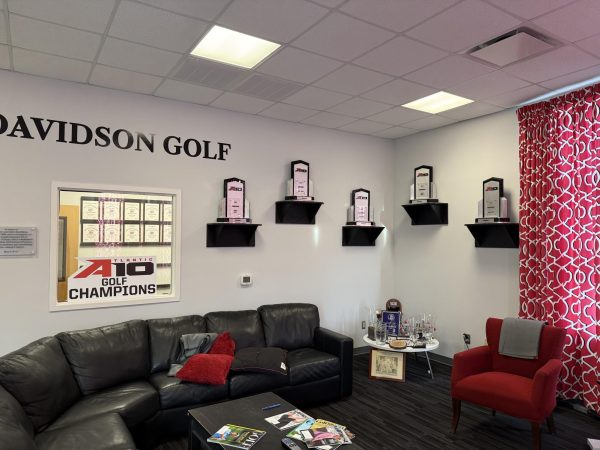
Pressure, in this case, has made diamonds. Five A-10 Championship trophies adorn the common room wall inside the Graeme and Gloria Kieth Davidson Golf House, which sits to the right of the team’s private range section. The program took home its first title in 2018, then won three-in-a-row between 2021-23. Their most recent title came in 2025, after overcoming a nine-stroke deficit on the final day of the tournament. As for the feeling of sustained success, Straub summed it up plainly: “It’s been fun.”
Aside from Davidson’s academic reputation, the conference titles attracted much of the current roster. “From the golf side, I saw [Davidson was] winning a lot of conference championships, and [I] definitely could tell they had great coaching from when I had talked to Coach Straub,” Nate Faulkner ’28 said.
Before Jackson Bode ’26 committed to Davidson, the program had already claimed two conference titles; it seemed “like a great spot,” said Bode.
Consistency at the collegiate level begins with recruiting. After 26 years as head coach, Straub knows what he prioritizes. The first trait Straub looks for is strong academics. Next is their ability to beat their high school and junior golf peers, “because those people [they] have to beat in college, too.”
Straub also likes to see recruits demonstrate “the ability to keep improving”—a hallmark of his coaching philosophy. Rather than setting team objectives like winning a conference championship and returning to NCAA Regionals, Straub emphasizes to players that getting better in all facets of their game is the goal.
“Hard work is the most important thing,” Straub said. “If you put the time in, you’re going to see results.”
Mental performance coach and assistant golf coach, L.D. Simmons ’81 helps players sharpen their mental games as well as their physical ones. Former Division I golfer, Simmons draws on his competitive experiences to teach course management—on-course strategies golfers use to approach different shots and holes.
On the strictly mental side, Simmons focuses on what he calls “the controlables.” He said the number one ranked golfer in the world could hit 100 shots from the same place, but couldn’t accurately predict whether one shot would land within five yards of the pin, and another would land twenty yards from the pin.
“We literally don’t control our golf swing, but there are a lot of things that we can control,” Simmons said. He teaches his players to visualize a “clear intention:” picture in their minds the kind of shot they want to hit before they hit it.
“You’ve got the best chance of hitting a quality golf shot if you’re able to really make a good decision about where you want that ball to finish, and create a picture in your mind of what that shot looks like,” Simmons said.
Simmons also teaches his players to practice acceptance. “It’s the ability to be willing to accept [a shot] that goes two feet from the hole and at the same time, be willing to see it go out of bounds, and be equally prepared to hit the next shot. It’s pre-loaded, preset acceptance,” Simmons explained.
Mental work extends beyond the course. Simmons encouraged players to start journaling their thoughts throughout the weeks. Faulkner uses his journal as a reference to maintain successful mental practices.
“A lot of times you can play well, and you were thinking really well, but then [a] couple of weeks or months later, if you’re not playing well, then it’s helpful to have [a record of] exactly what you were doing well a while ago so that you can go back to it,” Faulkner said.
For Simmons, Davidson golf is a family affair. All three of Simmons’ children attended Davidson; his two sons played under Straub. After practicing law for 35 years, Simmons opened his own private coaching practice and later began working with the team in 2020.
Helping to bring success to his alma mater has been “a great joy.”
“I get to help young people chase a dream,” Simmons said.
Back at practice, most of the team peeled off the practice facilities and headed onto the course. A few players stayed behind to keep hitting at the range. Clayton Couey ’28 was one of them.
This season, Couey is taking cues from the pros. He said he is trying to channel their focus on efficiency, diligence, and “getting everything out of every shot they’re hitting.”
He admitted that he had been playing mechanically lately, focusing too much on dialing in his swing rather than just “playing golf again.”
Echoing Simmons’ teachings, Couey is leaning away from the mechanical and grounding himself in “the controllables.”
“I’ve been so focused on how my swing is,” Couey said. “It’s gotten in the way of actually just hitting some shots, [and] focusing on just finding a target.”
Simmons gave credit to the team holistically for battling out of this mechanical mentality in favor of a mentality focused on simplying playing golf.
“I think across the board, they’ve done a good job of embracing the idea that we can play great golf without great mechanics,” Simmons said.
Without great mechanics, a great mindset becomes all the more important. Written on the whiteboard in the Davidson Golf House is a scoreboard for the team’s new season-long game.
“We have three teams of three: red, black and white,” Faulkner explained. “During practice, we’ll have competitions where we rotate from station to station and do a drill and keep a score, and the goal at the end of the season is to come out with the most points.”
It’s another pressure simulator that focuses the players, pitting them against one another in a well-intentioned fashion.
“I love playing against certain guys on the team,” Sayman said. “I want to go out and beat them and they want to beat the crap out of me. Same thing [with] qualifying: iron sharpens iron.”
Bode credits the team competitions for focusing the golfers each practice, calling it a “winning every day kind of thing.” While the winners are promised an end-of-season reward, the real benefit for Bode and the others is the commitment it generates.
“Whoever accumulates the most points throughout the semester will win some prize, whether it’s a pair of Footjoy shoes or maybe a club or something like that,” Bode said. “[The competition] keeps practice competitive and keeps guys in it, and forces them to really care each and every day.”
As each player prepared for the qualifier, they tried to put their disappointing opener out of mind.
“I don’t think anybody really addressed the team as a whole, but I think we all kind of talk about it within ourselves, kind of one-on-one, or in groups of three or four or something,” Bode said.
Sayman attributes some of the growing pains to a younger team; Bode and Price Miller ’26 are the only seniors on the roster. As a junior, Seyman recognized he is poised to step into a leadership role.
“I would love to be that guy, and I’m trying to set a good role model for the younger guys,” Sayman said. “Some people may call me a leader, some may not. I just be myself [and] lead that way.
Bode leads the team as a calming, friendly presence. He aspires to maintain a competitive edge in practice while cultivating “a space where we can all become as close of friends as we need to be.”
“I try to lead by example in that way, and spark conversation whenever I can, and be there if teammates need someone to talk to in any space,” Bode said.
Bode’s leadership philosophy draws on his experiences as an underclassman, where he observed how senior-led camaraderie can make all the difference.
“When I was a freshman, the two seniors on the team were just super fun, hard workers, and definitely made practice an enjoyable time. And that’s what I kind of try to do for the team,” Bode said. “When golf can sometimes feel like a job and become a monotonous task, our practices should be a space where guys enjoy being there and enjoy the guys around them, and I think that’s probably the most important part.”
Scribbled in the top left corner of the whiteboard above the team score tallies is an affirmation: “Golf like an A-10 champion TODAY!” For Faulker, it is a reminder not of the end goal, but of the work it takes to get there—of the standard the team strives to uphold each practice.
“It definitely does give us confidence coming back [to the A-10 Tournament], because it’s never a question of, ‘are we good enough to do it?’” Faulkner said.
Sayman sees the conference championship as a stepping-stone, a threshold they have to cross to get to the next level and compete on the national level.
“We want to push past [the A-10 championship]. We’re not doing great this season by any means, but we all see the bigger fish in the sea past the A-10s,” Sayman said. “I think I’m speaking for a lot of the guys in the locker room: we want to go to the [NCAA] regional and compete there.”
Davidson’s winning ways set a high standard. Bode feels confident the team will rise to the occasion.
“It is the new standard at Davidson. We all really want to win an A-10 Championship every year,” Bode said. “It’s definitely some pressure, but I don’t think it’s too much pressure that anyone on our team can handle. We can definitely get that done.”
